Adding integers
The code in this and previous blog posts can also be found here, on Codeberg. Check out the repo at the commit marked “blog 13”.
I hope you’re a bit disappointed that I didn’t manage to publish this blog post last Friday already. In my defense, I was busy being at a conference: the MPS Community Meetup 2026. You could regard this conference as a “LangDev for industry”. Of course, AI was a major talk of the town here as well. Interesting talks were presented, and spirited discussions were had — maybe more on that later on in a separate blog post.
In this blog post, we’re going to add integers. More precisely, we’re going to add:
- An
IntegerTypetype. - An
IntegerLiteralliteral. - Literals
addandmul– short for addition, and multiplication, respectively – to theBinaryOperatorenumeration. - A
UnaryOperationoperation for unary operations. A unary operation is an operation that consists of a unary operator and a single operand value. - A
UnaryOperatorenumeration with enumeration literals for the arithmeticneg– short for negation – and booleannotunary operators.
As a diagram:
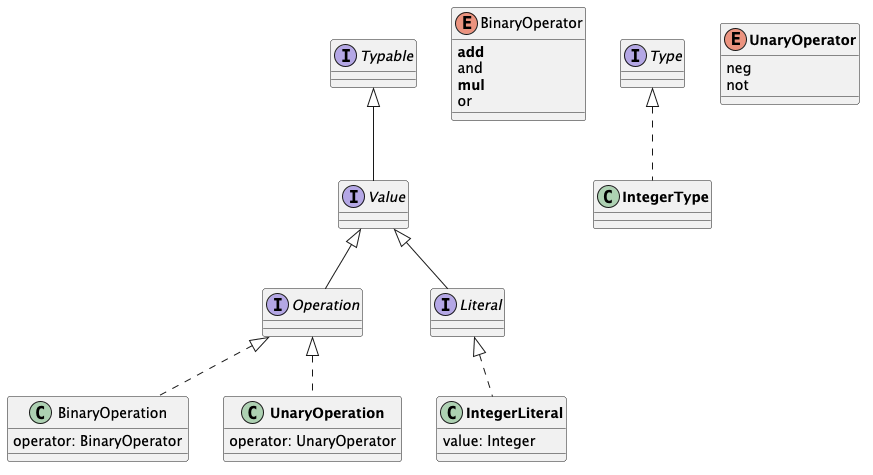
We’re going to extend MyFPL’s structure, the shorthands, the Projection function, the reducer, and the type computer. We’re also extending the example, and the unit tests, to verify all this is working.
We introduce integers (including associated operations/operators) primarily to have something to type check, because with these things we can create values such as 1 + false. Type checking is done by having type constraints checked by the constraints checker. We’ll start implementing the constraints checker, as well as various constraints, in the next blog post. Obviously, type checking relies on the type computer being able to compute types.
Our activities will follow the usual pattern of extending MyFPL’s key aspects:
Structure
Extend MyFPL’s structure by adding the necessary classifiers.
Notation
Extend the Projection function for the new classifiers.
Meaning
Extend the reduced reducer function for the new classifiers.
Constraints
Extend the typeOf type computer function for the new classifiers. We’ll implement a constraints checker – which is the missing other half of this aspect – in the next blog post.
We’ll also extend the example code and the unit tests accordingly.
Alternatively, you could use an LLM to modify the code. (I know…“Et tu, Brute?”) Probably, there’s just enough “meat” to MyFPL’s implementation’s “bones” for an LLM to recognize patterns, and to be able to extend the implementation accordingly.
If you want to use an AI, consider using an open-source, open-weights, privacy-friendly LLM that’s not provided by Big Tech bros operating from countries with questionable foreign loyalties. I myself use Mistral.
Extending MyFPL’s structure
First, we modify some existing code, in the packages/build/src/structure.ts file:
const { booleanDataType, integerDataType } = builtinsFacade.primitiveTypes ❶

// ...(other lines of existing code)...

;["add", "and", "mul", "or"].forEach((op) => factory.enumerationLiteral(BinaryOperator, op)) ❷- Also destructure the `integerDataType from the built-in primitive types — we’ll need that in the next listing.
- Add enumeration literals for the
addandmuloperators to theBinaryOperatorsenumeration.
Then, we add the following code (in its entirety), again to the packages/build/src/structure.ts file:
const IntegerLiteral = factory.concept("IntegerLiteral", ConceptModifier.concrete).implementing(Literal) ❶
factory.property(IntegerLiteral, "value").ofType(integerDataType)
factory.concept("IntegerType", ConceptModifier.concrete).implementing(Type) ❷

const UnaryOperator = factory.enumeration("UnaryOperator") ❸
;["net", "not"].forEach((op) => factory.enumerationLiteral(UnaryOperator, op))

const UnaryOperation = factory.concept("UnaryOperation", ConceptModifier.concrete).implementing(Operation) ❹
factory.property(UnaryOperation, "operator").ofType(UnaryOperator)
factory.containment(UnaryOperation, "operand").ofType(Value)- Create a literal concept
IntegerLiteral. - Create a type concept
IntegerType. - Create an enumeration
UnaryOperatorwith enumeration literalsnegandnot. - Create an operation concept
UnaryOperation.
Now run the NPM generate task in the build package, so the corresponding TypeScript types get created.
We’ll also extend the Shorthands class, as follows:
integerLiteral(value: number) { ❶
    if (!Number.isInteger(value)) { ❷
        throw new Error(integerLiteral shorthand only takes integers, not ${value})
    }
    const node = IntegerLiteral.create(newId())
    node.value = value
    return node
}

unaryOperation(operator: UnaryOperator, operand: Value) { ❸
    const node = UnaryOperation.create(newId())
    node.operator = operator
    node.operand = operand
    return node
}

get typeShorthands() {
    return {
        booleanType: () => BooleanType.create(newId()),
        integerType: () => IntegerType.create(newId()) ❹
    }
}- Define a
integerLiteral(<integer value>)shorthand function. - Check that the given
valuereally is an integer (as far as JavaScript is concerned), throwing an old-fashionedErrorifvalueis not an integer. - Define a
unaryOperation(<unary operator>, <operand>)shorthand function. - Add a
integerType()function inside thetypeShorthandsproperty ofShorthands.
We’ll use these additional shorthand functions in both the reducer, the type computer, in the example code, and in the unit tests.
Extending the projection
Next, we extend the Projection function, in the packages/my-fpl/src/projection.tsx file:
const displayOfBinaryOperator = (operator: BinaryOperator) => { ❶
    switch (operator) {
        case BinaryOperator.add: return "+"
        case BinaryOperator.mul: return "*"
        default: return operator
    }
}

const displayOfUnaryOperator = (operator: UnaryOperator) => { ❷
    switch (operator) {
        case UnaryOperator.neg: return "-"
        default: return operator
    }
}

export const Projection = ({ node }: { node: INodeBase }) => {

    if (node instanceof BinaryOperation) {
        return <div className="inline" title={titleTextFor(node)}>
            <Projection node={node.left} />
            <span className="keyword ws-both">{displayOfBinaryOperator(node.operator)}</span> ❸
            <Projection node={node.right} />
        </div>
    }

    // ...existing code...

    if (node instanceof IntegerLiteral) { ❹
        return <span className="literal" title={titleTextFor(node)}>{node.value}</span>
    }

    if (node instanceof IntegerType) {
        return <span className="type">Integer</span>
    }

    // ...more existing code...

    if (node instanceof UnaryOperation) {
        return <div className="inline" title={titleTextFor(node)}>
            <span className="keyword ws-right">{displayOfUnaryOperator(node.operator)}</span>
            <Projection node={node.operand} />
        </div>
    }

    // ...more existing code...

}- Add a
displayOfBinaryOperatorthat returns the keyword to display for the given binaryoperator. I do this because the strings “+” and “*” aren’t valid names of enumeration literals, but I’d like to stick to traditional notation, instead of “add” and “mul”. - Add a
displayOfUnaryOperatorfunction that does a similar thing for the given unaryoperator: for thenegenumeration literal is mapped to “-”, whilenotremains the same. - Use the new
displayOfBinaryOperatorfunction in theif-statement forBinaryOperation. - Add
if-statements forIntegerLiteral,IntegerType, andUnaryOperation, essentially copying the pattern ofBooleanLiteral,BooleanType, andBinaryOperation, respectively.
Extending the reducer
The next stop on our itinerary is extending the reducer functions, in the packages/my-fpl/src/reducer.ts file. First, we destructure some more shorthand functions:
const { ..., integerLiteral, unaryOperation } = new Shorthands()Then, inside the reducedBinaryOperation function, we define additional leftIsInteger, and rightIsInteger boolean constants:
const leftIsInteger = reducedLeft instanceof IntegerLiteral
// (2 lines in between)
const rightIsInteger = reducedRight instanceof IntegerLiteral
Now, inside the switch-statement inside the reducedBinaryOperation function, add the following two cases:
case BinaryOperator.add:
    return (leftIsInteger && rightIsInteger)
        ? integerLiteral(reducedLeft.value + reducedRight.value)
        : binaryOperation(operator, reducedLeft, reducedRight)

case BinaryOperator.mul:
    return (leftIsInteger && rightIsInteger)
        ? integerLiteral(reducedLeft.value * reducedRight.value)
        : binaryOperation(operator, reducedLeft, reducedRight)
This code reduces a binary operator with a add or mul operator only if both operands reduce to integers (in the form of integer literals). If that’s not the case, a binary operation with that operator, and the reduced operands, is returned.
All that is left is to implement the reduction of a UnaryOperation, by adding the following code inside the reduced function:
if (value instanceof UnaryOperation) {
    const reducedOperand = reduced(value.operand)
    if (reducedOperand instanceof BooleanLiteral && value.operator === UnaryOperator.not) {
        return booleanLiteral(!reducedOperand.value)
    }
    if (reducedOperand instanceof IntegerLiteral && value.operator === UnaryOperator.neg) {
        return integerLiteral(-reducedOperand.value)
    }
    return unaryOperation(value.operator, reducedOperand)
}
This code reduces a value of the form not <boolean operand>, or neg <integer operand> to the boolean, respectively, arithmetic negation of the reduced operand. If the unary operator doesn’t match the type of the (reduced) operand, a unary operation with that operator, and the reduced operand, is returned.
Extending the unit tests for the reducer
To test whether the additions above work correctly, we’re going to add unit tests to the packages/test/src/reducer.tests.ts file. Before anything, let’s make our lives a bit easier by destructuring some more often-used items:
const { ..., integerLiteral, unaryOperation } = new Shorthands()
const { add, and, mul, or } = myFPL.BinaryOperator
const { neg, not } = myFPL.UnaryOperator
We also add another convenience function, similar to expectBoolean, that checks whether a value is an integer literal with a certain integer value:
const expectInteger = (value: myFPL.Value, expected: number) => {
    expect(value).to.be.instanceof(myFPL.IntegerLiteral)
    expect((value as myFPL.IntegerLiteral).value).to.equal(expected)
}
Now, let’s check whether an integer literal reduces to the same integer literal. To do that, we add an it-section named “integers” to the describe-section named “reduction of literals”:
it(`integers`, () => {
    expectInteger(reduced(integerLiteral(0)), 0)
    expectInteger(reduced(integerLiteral(1)), 1)
})
Then, let’s check whether a binary operation involving arithmetic operators and integer operands works correctly. We do that by adding two it-sections to the describe-section named “reduction of binary operations”:
it(`integer operands with +/* operators`, () => {
    const value = binaryOperation(
        add,
        integerLiteral(1),
        binaryOperation(mul, integerLiteral(2), integerLiteral(3))
    )
    expectInteger(reduced(value), 1 + 2 * 3)
})

it(`true + 3 reduces no further`, () => {
    const unreducedValue = binaryOperation(add, trueLiteral(), integerLiteral(3))
    const addReduction = reduced(unreducedValue)
    expect(addReduction).to.be.instanceof(myFPL.BinaryOperation)
    const reducedBinOp = addReduction as myFPL.BinaryOperation
    expect(reducedBinOp.operator).to.equal(add)
    expectBoolean(reducedBinOp.left, true)
    expectInteger(reducedBinOp.right, 3)
})
Finally, let’s add an entirely new describe-section that checks whether the reduction of unary operations works correctly:
describe(`reduction of unary operators`, () => {

    it(`works as expected when operator and type of operand match`, () => {
        expectBoolean(reduced(unaryOperation(not, trueLiteral())), false)
        expectBoolean(reduced(unaryOperation(not, falseLiteral())), true)

        expectInteger(reduced(unaryOperation(neg, integerLiteral(1))), -1)
        expectInteger(reduced(unaryOperation(neg, integerLiteral(-1))), 1)
    })

    it(`stalls when operator and type of operand don’t match`, () => {
        const negBooleanReduction = unaryOperation(neg, falseLiteral())
        expect(negBooleanReduction).to.be.instanceof(myFPL.UnaryOperation)
        const reducedNegBoolean = negBooleanReduction as myFPL.UnaryOperation
        expect(reducedNegBoolean.operator).to.equal(neg)
        expectBoolean(reducedNegBoolean.operand, false)

        const notIntegerReduction = unaryOperation(not, integerLiteral(1))
        expect(notIntegerReduction).to.be.instanceof(myFPL.UnaryOperation)
        const reducedNotInteger = notIntegerReduction as myFPL.UnaryOperation
        expect(reducedNotInteger.operator).to.equal(not)
        expectInteger(reducedNotInteger.operand, 1)
    })

})
Extending the type computer
Next, we modify the typeOf type computer function, in the packages/my-fpl/src/type-computer.ts file, for the added classifiers:
const { booleanType, integerType } = typeShorthands ❶

export const typeOf = (typable: Typable): Type => {
    if (typable instanceof BooleanLiteral) {
        return booleanType()
    }
    if (typable instanceof BinaryOperation) {
        switch (typable.operator) { ❷
            case BinaryOperator.add:
            case BinaryOperator.mul:
                return integerType()
            case BinaryOperator.and:
            case BinaryOperator.or:
                return booleanType()
            default: throw new Error(binary operator not handled: ${typable.operator})
        }
    }
    if (typable instanceof IntegerLiteral) { ❸
        return integerType()
    }
    if (typable instanceof UnaryOperation) { ❹
        switch (typable.operator) {
            case UnaryOperator.neg: return integerType()
            case UnaryOperator.not: return booleanType()
            default: throw new Error(unary operator not handled: ${typable.operator})
        }
    }
    throw new Error(concept not handled by typeOf: ${typable.classifier.name})
}- Also destructure the
integerTypefrom the type shorthands. - Instead of always returning an instance of
BooleanType, we let the binary operator decide the type byswitch-ing over it. We also provide adefault-case to warn us – as language developers – about operators we fail to handle. - Instances of
IntegerLiteralare typed as instances ofIntegerType. - Handle an instance of
UnaryOperationbyswitch-ing on the unary operator. Again, we also provide adefault-case to warn us about missed operators.
Apart from the typeOf function, we also have to extend the typeAsText function by adding an if-statement handling instances of IntegerType:
if (type instanceof IntegerType) {
    return "integer"
}
A design choice
Values like true and false and 1 + 2 are obviously boolean-, respectively integer-typed. But what about a binary operation where the binary operator doesn’t match the type of the left or right operand (or both)? As an example: what would be a sensible type for true + 3? We could let the type of such a “faulty” value be determined by:
- The binary operator —
add. - The type of the reduction of the left operand — boolean.
- The type of the reduction of the right operand — integer.
The same question can be raised for values such as neg true or not 1 that are unary operations where the unary operator doesn’t match the type of the reduced operand. For both kinds of situations, the reducer stops at the operands, so it’s really up to the type computer to determine the type. In other words: this is a design choice!
I choose to let the operators determine the type, while also producing a type constraint violation – after we implement a constraints checker – that explains the mismatch between operator and operand(s). That way, the type computation is only dependent on the operation node itself. For our example, we compute the type of true + 3 to be integer.
I feel this approach produces clear feedback to MyFPL programmer, while not forcing them to change the value in a way that might not align with their intentions. E.g., for neg true: did the MyFPL programmer intend to use the not operator, or did they intend to produce an integer as operand, rather than a boolean?
“Following” the operator most obviously aligns with the apparent intent of the MyFPL programmer. It also avoids having to choose between propagating the type of the reduction of either the left, or right operand of the binary operator.
Extending the unit tests for the reducer
To test whether the additions above work correctly, we’re going to add unit tests to the packages/test/src/type-computer.tests.ts file. First, extend the destructuring the same way we did for the reducer tests:
const { ..., integerLiteral, unaryOperation } = new Shorthands()
const { add, and, mul, or } = myFPL.BinaryOperator
const { neg, not } = myFPL.UnaryOperator
Now, add an expect-ation to the it-section named “literals”:
expect(typeOf(integerLiteral(1))).to.be.instanceof(myFPL.IntegerType)Then, add new cases to the it-section named “binary operations”:
const addOperation = binaryOperation(
    add,
    integerLiteral(1),
    integerLiteral(2)
)
expect(typeOf(addOperation)).to.be.instanceof(myFPL.IntegerType)

const mulOperation = binaryOperation(
    mul,
    integerLiteral(2),
    integerLiteral(3)
)
expect(typeOf(mulOperation)).to.be.instanceof(myFPL.IntegerType)
Finally, add a new it-section:
it(`unary operations`, () => {
    expect(typeOf(unaryOperation(neg, integerLiteral(1))))
    expect(typeOf(unaryOperation(not, trueLiteral())))
})
Extending the example program
Now, we finally extend the example program – in the packages/src/my-fpl/example.ts file – with a couple of values that involve integers, and negation.
First, we perform the usual modification of the destructurings:
const { ..., integerLiteral, program, unaryOperation } = new Shorthands()
const { trueLiteral, falseLiteral } = booleanShorthands
const { add, and, mul, or } = BinaryOperator
const { neg, not } = UnaryOperator
Now, we can add the following value instantiations:
myProgram.addValues(binaryOperation(add, integerLiteral(5), integerLiteral(3)))
myProgram.addValues(binaryOperation(mul, integerLiteral(4), integerLiteral(7)))

myProgram.addValues(unaryOperation(not, trueLiteral()))
myProgram.addValues(unaryOperation(neg, integerLiteral(10)))

myProgram.addValues(unaryOperation(neg, binaryOperation(add, integerLiteral(5), integerLiteral(3))))
myProgram.addValues(unaryOperation(not, binaryOperation(and, falseLiteral(), trueLiteral())))
After running npm run build and node dist/example.js, loading packages/src/example.html in the browser gives a new piece of page:
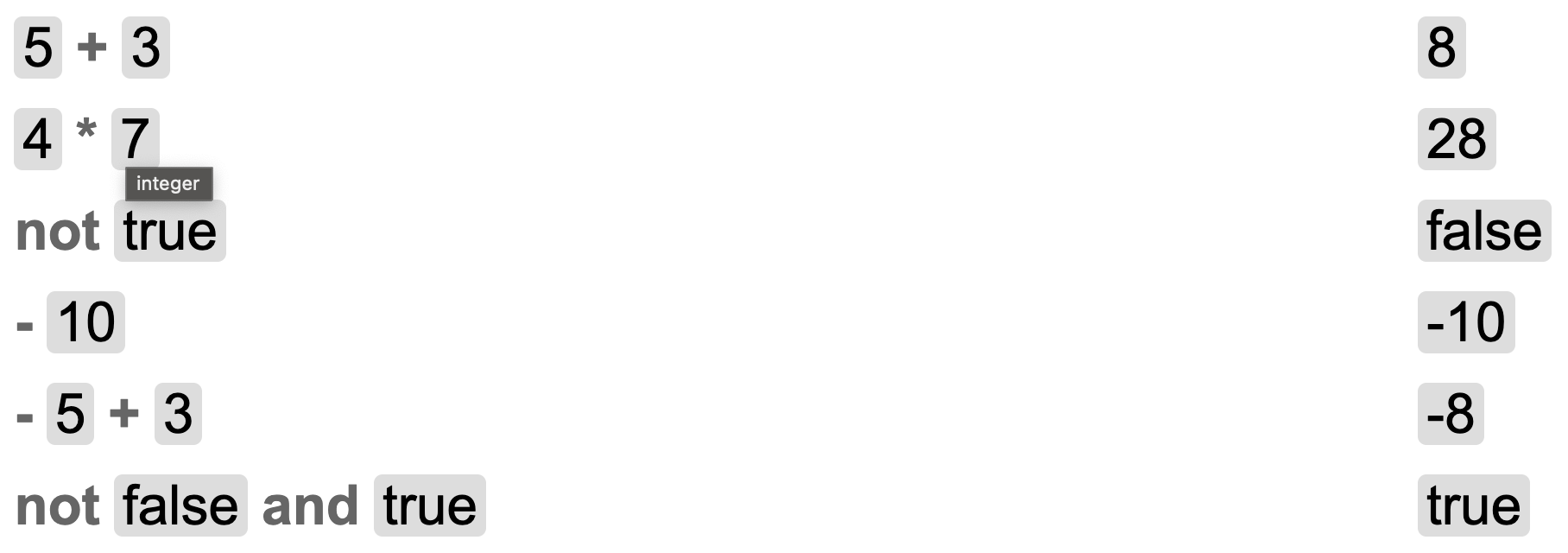
You see in the screenshot above that the last two values look ambiguous in this notation: we could interpret them to mean either (-5) + 3 or -(5 + 3), and (not false) and true or not (false and true) — using the concept of parentheses that we haven’t introduced to MyFPL (yet). In a next blog post, we’re going to discuss a technique to clarify such values, taking operator precedence into account.
© 2026 Meinte Boersma (DSL Consultancy)